If you’re planning an LED video wall, one question always comes up early:
How much electricity will an LED video wall consume per hour, per day, and per month?
This guide gives you a simple LED wall power consumption calculator, real examples (indoor + outdoor), and a practical checklist for power planning in India.
Quick answer: How much electricity does an LED video wall use?
LED video wall power usage depends mainly on screen size, brightness, and whether it’s indoor or outdoor.
A practical rule for planning is to estimate using average power, not max power (max is the peak limit and rarely sustained).
Typical indoor LED video wall power consumption
- Average: ~200–400 W per m²
- Maximum (peak): ~600–800 W per m²
Typical outdoor LED video wall power consumption
- Average: ~350–600 W per m²
- Maximum (peak): ~800–1200 W per m²
If you want a fast estimate right now:
Monthly cost (₹) ≈ (Area in m² × Avg W/m² ÷ 1000) × Hours/day × 30 × ₹/kWh
LED video wall power consumption calculator
You don’t need to be an engineer to estimate consumption. Use this 4-step method.
Step 1: Calculate screen area (m²)
Area (m²) = Width (m) × Height (m)
If your size is in feet:
- Meters = feet × 0.3048
- So, Area (m²) = (W ft × 0.3048) × (H ft × 0.3048)
Step 2: Choose average power (W/m²)
Pick a realistic average based on your use case:
- Indoor (typical): 250–350 W/m²
- Outdoor (typical): 400–600 W/m²
If you don’t know what to choose:
- start with 300 W/m² indoor
- start with 500 W/m² outdoor
Step 3: Convert to kW (kilowatts)
kW = (Area × Avg W/m²) ÷ 1000
Step 4: Calculate energy usage (kWh)
kWh/day = kW × Hours/day
kWh/month = kWh/day × 30
Step 5: Estimate electricity cost
Monthly cost (₹) = kWh/month × Your tariff (₹/kWh)
Typical commercial tariffs vary by city/state and category, but many businesses use a planning number like ₹8 to ₹12 per kWh.
Example 1: 10 ft × 6 ft Indoor LED Video Wall — 12 hours/day
- Average power: 300 W/m² (indoor typical)
- Electricity rate: ₹11 per kWh (planning rate for Mumbai commercial)
Step 1 — Area
- 10 ft = 3.048 m
- 6 ft = 1.829 m
- Area = 3.048 × 1.829 = 5.57 m²
Step 2 — Average load (kW)
- kW = (5.57 × 300) ÷ 1000
- kW = 1.67 kW
Step 3 — Monthly units (kWh)
- Daily kWh = 1.67 × 12 = 20.0 kWh/day
- Monthly kWh = 20.0 × 30 = 600 kWh/month
Step 4 — Monthly cost (Mumbai)
- Cost = 600 × ₹11 = ₹6,600/month
✅ Estimated monthly electricity cost in Mumbai: ~₹6,600/month
Example 2: 20 ft × 10 ft outdoor LED video wall (10 hours/day)
Area
- 20 ft = 6.096 m
- 10 ft = 3.048 m
- Area ≈ 6.096 × 3.048 = 18.58 m²
Assume outdoor average power
- Outdoor average assumption: 500 W/m²
kW
- kW = (18.58 × 500) ÷ 1000 = 9.29 kW
Monthly kWh
- Daily: 9.29 × 10 = 92.9 kWh/day
- Monthly: 92.9 × 30 = 2,787 kWh/month
Cost
- At ₹10/kWh → ₹27,870/month
✅ Estimated monthly electricity cost: ~₹27,870/month (at ₹10/kWh)
Example 3: Retail showroom LED wall running 14 hours/day (indoor)
Retail often runs long hours, so runtime matters more than many people expect.
Use the same formula:
- compute area
- multiply by realistic average W/m²
- multiply by 14 hours/day
- multiply by ₹/kWh
If your wall is on all day, optimizing brightness and content can save a lot.
What affects LED video wall power consumption the most?
1) Brightness level (nits) and brightness settings
Running at 100% brightness all day can dramatically increase power usage—especially outdoors. If your wall supports adaptive brightness, it can help reduce consumption during evenings.
Related reading: your brightness guide on the blog.
2) Content type (white content uses more power)
LED walls draw more power when showing bright scenes:
- full white background
- bright product shots
- large white text blocks
A mostly dark content playlist can reduce average power significantly.
3) Indoor vs outdoor build
Outdoor walls usually require higher brightness, weather protection, and thermal design, which increases average consumption.
Explore:
- Indoor: /our-products/indoor-advertising-display/
- Outdoor: /our-products/outdoor-display-screen/
4) Power supply efficiency and system design
Better power supplies and proper distribution reduce losses and improve stability.
Power planning checklist (what to ask before installation)
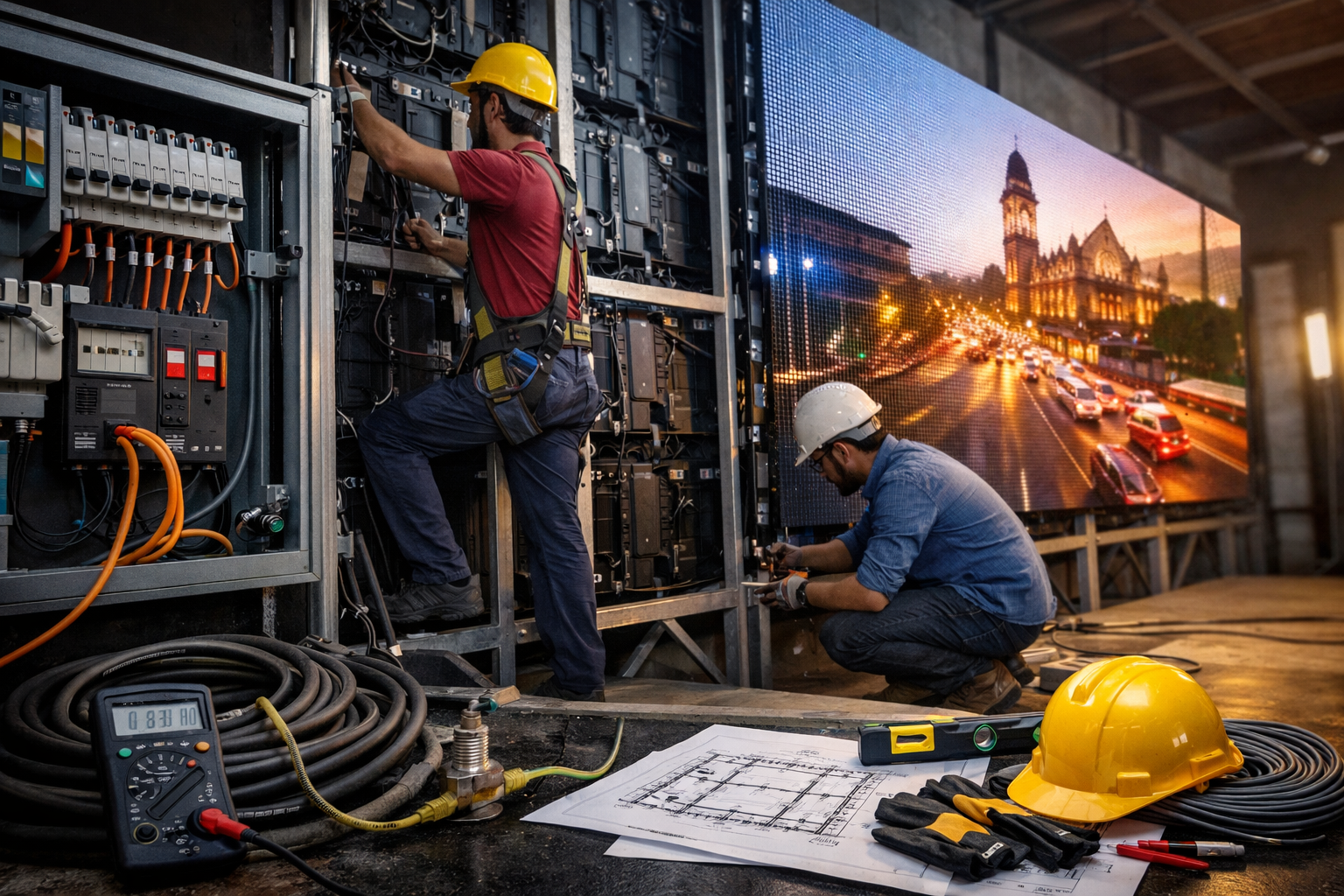
If you’re planning a fixed installation, don’t estimate power only for the panels. Ask for the full system requirements:
Power supply sizing
Ask your vendor/installer:
- Total connected load (kW)
- Recommended circuits and breaker sizing
- Cable sizing and distribution layout
Earthing and safety
For India projects, proper earthing is non-negotiable.
UPS requirement for LED video wall
A common long-tail question is: Do LED video walls need a UPS?
It depends:
- If you need safe shutdown, protection from voltage dips, and uptime for critical areas (control rooms/corporate), UPS helps.
- For outdoor advertising where occasional outage is acceptable, UPS may be optional.
Generator sizing (events)
If it’s for events, ask for:
- recommended generator kVA
- startup surge planning
- power factor assumptions
Frequently Asked Questions
Power per hour (kWh) equals the wall’s kW rating × 1 hour.
Example: if your wall averages 2 kW, it uses ~2 kWh per hour.
A realistic planning range is:
Indoor: ~200–400 W/m² average
Outdoor: ~350–600 W/m² average
(Actual depends on brightness and content.)
A typical indoor 10×6 ft wall running 12 hours/day can be around ~600 kWh/month, which is ~₹6,000/month at ₹10/kWh (approximate).
Yes. Higher brightness usually means higher average power draw. Outdoor walls often consume more because they run brighter.
Outdoor walls typically use more power because they need higher brightness and rugged design. Indoor walls often run at lower brightness with lower average W/m².
Not always, but UPS is recommended for critical environments or where power quality is unstable. It helps prevent abrupt shutdowns and protects electronics.